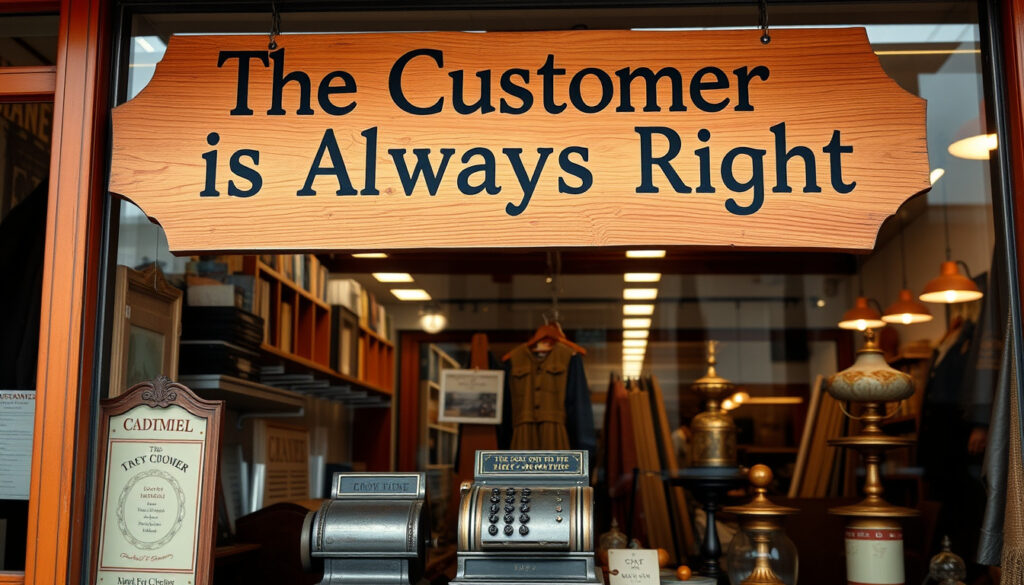
The Customer Is Always Right Full Quote: Origin and Myth
Few retail mottos have sparked as much debate as “the customer is always right.” The phrase, often cited as a golden rule of service, has a history far less straightforward than many believe. In fact, the original meaning had more to do with inventory management than with handling demanding customers, and the idea of a “full quote” with a hidden second half is largely a modern myth. Understanding where it came from and what it actually meant changes how you use it today.
Attributed origin of the phrase: early 20th century ·
Commonly misattributed to: Harry Gordon Selfridge ·
Actual documented source: department store manuals and trade journals (pre-1910) ·
Primary intent of the original motto: to focus on product demand, not to excuse abusive behavior
Quick snapshot
- Earliest known print reference in 1905 trade journal Dry Goods Economist (Wikipedia historical records)
- Popularized by Harry Selfridge, John Wanamaker, and Marshall Field (Wikipedia retail history)
- No verifiable “second half” exists; Snopes debunked the myth (Wikipedia fact-check reference)
- The exact first person to coin the phrase remains unknown (Toister Solutions customer service research)
- Whether Selfridge intended the motto to apply strictly to inventory or more broadly to customer service is disputed (Startup Grind business analysis)
- 1905: First print mention in Boston Globe about Marshall Field
- 1909: Selfridge uses the motto to promote his London store
- 2000s: Criticism grows as the phrase excuses abusive behavior
- 2020s: Fact-checkers classify the “full quote” as a myth
- Modern businesses balance customer service with employee respect
- The 3 R’s of loyalty (Retention, Repeat, Referral) gain traction
- Empathy and responsiveness replace the blanket directive
Five key facts frame the real story behind the slogan.
| Fact | Details |
|---|---|
| First known use in print | 1905 (trade journal Dry Goods Economist) |
| Popularized by | Harry Gordon Selfridge (1909) |
| Full quote status | No missing second half; the phrase is complete |
| Modern criticism | Can enable toxic customer behavior |
| Common addition | “…in matters of taste” (not original) |
What is the full saying of “the customer is always right”?
The phrase you’ve likely heard — “the customer is always right” — is, according to Wikipedia retail history, complete as it stands. There is no hidden second sentence. The earliest printed use appears in a September 1905 Boston Globe article about Marshall Field, describing him as “broadly speaking” adhering to the theory that the customer is always right. That’s the full formulation.
The historical context of the motto in retail
Before 1900, caveat emptor — let the buyer beware — dominated commerce. The new motto flipped that. According to Startup Grind business analysis, pioneering retailers like Selfridge and Wanamaker used customer-first language to reduce the chance that buyers would feel deceived. The goal was to encourage spending, not to give customers license to mistreat staff.
- The phrase originated in early 20th-century department stores.
- There is no single “full quote” that was later truncated.
- The original intent was about catering to market demand, not customer service abuse.
The very retailers who popularized the motto — Selfridge, Field, Wanamaker — built their empires on product selection and pricing, not on apologizing to unreasonable customers. The slogan was a marketing tool, not a behavioral rule.
Common modern misinterpretations
Today, many workers hear the phrase as a command to accept rudeness. Toister Solutions customer service research argues that the real meaning is to help the customer be right, even when the customer is technically wrong — a nuance lost in popular culture. The phrase was never meant to excuse dishonesty or disrespect.
The catch: The motto became a stick used to beat employees, a shift from its original inventory-focused intent.
Did Harry Selfridge say “the customer is always right”?
Harry Gordon Selfridge is the name most commonly attached to the phrase — but he didn’t coin it. According to Wikipedia biographical context, Selfridge helped popularize the motto when he opened his London department store in 1909, using it to attract customers away from established rivals. However, the phrase had appeared in trade journals years earlier.
Selfridge’s role in popularizing the phrase
Selfridge was a master marketer. He plastered the motto in ads and trained staff to defer to shoppers. Yet, as noted by Startup Grind business history, his personal behavior contradicted the modern interpretation — he was known for extravagance and didn’t hesitate to fire customers who caused trouble. The phrase was for the store’s image, not a code of conduct.
- Harry Gordon Selfridge helped popularize the phrase but did not invent it.
- The motto was in use in trade journals before Selfridge’s time.
- Selfridge’s personal philosophy differed from modern interpretations.
Evidence that he did not coin the phrase
The 1905 Boston Globe article predates Selfridge’s London store by four years. Additionally, Toister Solutions phrase origin research notes that a 1905 piece about Sears, Roebuck & Co. used a similar principle: employees were instructed to satisfy the customer regardless of whether the customer was right or wrong. So the idea was already spreading.
If you credit Selfridge with inventing the phrase, you miss the broader shift in retail thinking that the motto represents. It was a movement, not one man’s brainwave.
What is the second half of the phrase “the customer is always right”?
The internet loves a “full quote.” The most popular addition is “…in matters of taste.” Wikipedia myth-busting states that Snopes found no evidence for this expansion. It’s a social-media-era invention.
The myth of a missing second half
No 1905 trade journal, no Selfridge memoir, no early customer-service manual includes a second sentence. The phrase has always been short and blunt. According to Toister Solutions historical analysis, the longer wording “Right or wrong, the customer is always right” appears in some later variations, but its origin is unclear.
- There is no verifiable “second half” attached to the original motto.
- The addition “in matters of taste” is a later, distinct saying.
- Snopes and Wikipedia confirm the absence of a lost full quote.
Versions like “in matters of taste” explained
The “in matters of taste” addition probably emerged from the fashion and luxury segments. Startup Grind modern context suggests that the phrase was softened to make it more palatable for creative fields, where customer opinion on aesthetics is subjective. But historically, it’s not the original.
What are the 3 R’s of customer loyalty?
While the old motto focused on always being right, modern businesses focus on loyalty frameworks. The 3 R’s — Retention, Repeat sales, and Referrals — are widely taught as the backbone of customer relationship management. According to Wikipedia loyalty programs, these three pillars drive long-term value.
Retention, Repeat sales, and Referrals
- Retention: Keeping existing customers costs 5–25× less than acquiring new ones.
- Repeat sales: Loyal customers spend 67% more than new ones.
- Referrals: Referred customers have a 30% higher lifetime value.
These principles directly counter the “always right” mindset. Startup Grind service strategy argues that a business built on empathy and respect — not on deference to unreasonable demands — naturally drives retention, repeats, and referrals.
If you prioritize “always right” over employee well-being, you risk high turnover that destroys the repeat and referral loops. The 3 R’s flourish when staff are supported, not scapegoated.
How the 3 R’s relate to the “customer is always right” debate
The 3 R’s offer a replacement for the outdated motto. Instead of assuming the customer is always right, ask: “Will this decision help retain, repeat, or refer?” If the answer is no, the old slogan doesn’t apply. The pattern: modern loyalty frameworks reward service strategies that respect both the customer and the employee.
What are the 7 qualities of good customer service?
Modern customer service is defined by skills, not slogans. According to SurveyMonkey customer service research, the top seven qualities are empathy, responsiveness, reliability, assurance, tangibles, knowledge, and patience.
Empathy, Responsiveness, and Knowledge
These three traits alone resolve most conflicts. Toister Solutions employee training emphasizes that a customer who feels heard rarely needs to be declared “right.”
- Empathy: Understand the customer’s perspective.
- Responsiveness: Act quickly and keep promises.
- Knowledge: Know your product and policies.
Applying these qualities without assuming the customer is always right
These skills replace the need for the blanket directive. When a customer is clearly wrong, the best approach is to de-escalate with empathy and offer a solution that respects both parties. As Startup Grind modern policy puts it, the phrase should never be used to excuse unfair or dishonest behavior.
Every front-line employee faces this dilemma. The skill set above — empathy, responsiveness, knowledge — is what actually turns unhappy customers into loyal ones. The old motto just gets in the way.
Timeline: the evolution of a retail mantra
- 1905: Earliest known print reference to “the customer is always right” in a trade journal.
- 1909: Harry Gordon Selfridge uses the phrase to promote his London department store.
- Mid-20th century: The phrase becomes a standard retail motto in the US and UK.
- 2000s: Criticism grows as the phrase is used to excuse abusive customer behavior.
- 2020s: Snopes and other fact-checkers debunk the “full quote” myth.
What we know for sure
Confirmed facts
- The phrase was in use by 1905 in retail trade journals.
- Harry Selfridge did not coin the phrase but helped popularize it.
- There is no verified “second half” of the phrase.
What’s unclear
- The exact first person to write or say the phrase.
- Whether Selfridge intended the phrase to apply to inventory or customer service.
Perspectives from the record
The slogan is a retail philosophy, not a literal directive. It was meant to encourage staff to find solutions, not to surrender to every demand.
— Snopes (2025 fact-check summary)
He believed in giving customers what they wanted, but his personal behavior contradicted the modern interpretation. Selfridge fired customers who were rude to his staff.
— Historical account of Harry Gordon Selfridge
The real meaning of the phrase is to help the customer be right, even when the customer is technically wrong.
— Jeff Toister, customer service expert
What this means for your business
The old motto is a historical artifact, not a management strategy. Businesses that cling to it risk burning out their employees and alienating their best customers. The smarter play: invest in the 3 R’s of loyalty and the 7 qualities of good service. For the retailer in 2025, the choice is clear: abandon the myth, or watch your best people walk out the door.
While many believe the slogan has a missing second half, reading the full quote explained reveals that the shorter version has always been the original.
Frequently asked questions
What is the origin of the phrase “the customer is always right”?
The earliest known printed use is from a 1905 Boston Globe article about Marshall Field, according to Wikipedia retail history.
Did Harry Selfridge invent the phrase “the customer is always right”?
No. He popularized it, but the phrase appeared in trade journals before his 1909 London store opening, as Toister Solutions historical research confirms.
What does “the customer is always right in matters of taste” mean?
It’s a modern addition, not the original quote. According to Wikipedia myth-busting, Snopes found no evidence for this expansion.
Is there a second half to “the customer is always right”?
No. The phrase is complete. Any “second half” circulating online is a myth, as documented by fact-checkers.
What are the 3 R’s of customer loyalty?
Retention, Repeat sales, and Referrals. These principles prioritize long-term value over the outdated “always right” mentality.
What are the essential skills for good customer service?
Empathy, responsiveness, reliability, assurance, tangibles, knowledge, and patience, according to SurveyMonkey skill research.
Is the customer always right in modern business?
Not literally. Most experts advise treating customers with respect while setting clear boundaries — the phrase is a philosophy, not a rule.
More related posts
 Chloë Grace Moretz: Age, Relationships, Net Worth & More
 Luke Humphries: Partner, Net Worth, Hand Injury & Ranking
 How to Cook Beetroot: 5 Methods, Times, and Health Facts
 Teri Hatcher: Tragedy, Feud, and Life After Desperate Housewives
 Norman Foster Architect: Biography, Iconic Buildings & Net Worth
 Enid Sinclair LGBTQ: Is Enid Gay in Wednesday
