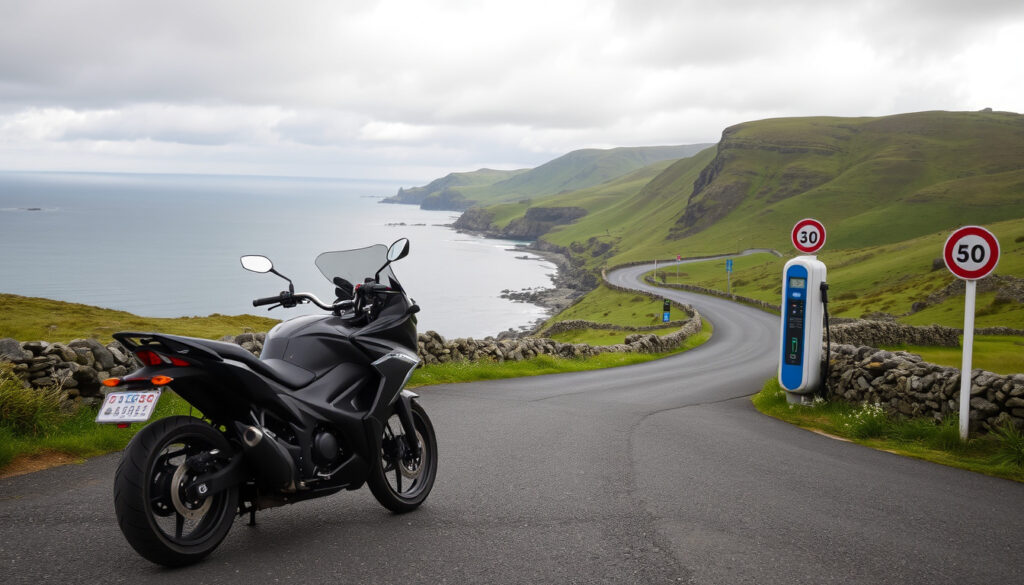
Electric Motorbikes Ireland: Licence, Speed, Pros & Cons (2025)
With rising fuel costs and a growing network of grants, more riders in Ireland are considering an electric motorbike. This guide covers licensing, speeds, costs, and the best models available on the Irish market in 2025.
Top speed: Up to 130 km/h (e.g., DMG-H model) ·
Power options: 3 kW to 10 kW ·
License threshold in Ireland: 11 kW (A1 or A license required above) ·
Fully electric motorcycle brands available: Super Soco, NIU, Harley-Davidson LiveWire ·
Typical price range in Ireland: €4,000 – €30,000
Quick snapshot
- Electric motorbikes over 11 kW require A1/A license in Ireland (SEAI SEAI grant guidance)
- SEAI grants €500 for L1e-B mopeds, €1,000 for L3 motorcycles (gov.ie announcement)
- Many models reach 100–130 km/h (Move Electric roundup)
- Exact number of public charging stations suitable for electric motorbikes in Ireland
- Average total cost of ownership compared to petrol over 5 years
- Long-term battery degradation data for popular models
- Effect of cold weather on real-world range for specific models
- Availability of fast-charging stations compatible with electric motorcycles in rural areas
- Feb 2025: Irish government confirms continuation of electric motorcycle grants (gov.ie press release)
- May 2025: New technical rules for e-scooters and e-bikes take effect (Lacey Solicitors summary)
- Expansion of Irish charging infrastructure expected through National EV Charging Network plan
- More brands entering the 11 kW category ideal for A1 license holders
Five key facts, one pattern: the Irish market is shaped by a clear power threshold that determines licensing requirements.
| Attribute | Value |
|---|---|
| Maximum speed (common models) | Up to 130 km/h |
| Typical range per charge | 100–250 km |
| Power / class | 3 kW to 10 kW (popular); 11+ kW (high-performance) |
| License requirement (Ireland) | Under 11 kW: A1; over 11 kW: A2/A |
| Price range (new) | €4,000 – €30,000 |
| SEAI grant L1e-B (≤45 km/h) | €500 |
| SEAI grant L3 (>45 km/h) | €1,000 |
| E-bike limit (no license) | 250 W, 25 km/h pedal-assist |
Do you need a licence for an electric motorbike in Ireland?
What is the electric motorcycle license category in Ireland?
In Ireland, the license you need depends on the power output and top speed of the vehicle. According to SEAI (the national energy authority), electric motorcycles are divided into L1e-B mopeds (capped at 45 km/h) and L3 motorcycles (exceeding 45 km/h). For any machine over 11 kW, a full motorcycle license (A1, A2, or A) is required. The Irish Department of Transport enforces these rules through Gardaí.
Is an electric motorbike road legal without a licence?
Low-power e-bikes (250 W, pedal-assist, 25 km/h cutoff) require no license, registration, or insurance, as confirmed by Lacey Solicitors (Irish legal advisory). However, once you step up to an electric moped or motorcycle, the same licensing and insurance rules apply as for petrol vehicles. E-mopeds up to 4,000 W and 45 km/h need an AM license and insurance.
The 11 kW cutoff means many popular commuter electric motorbikes (like the Super Soco TC Max at 4 kW) are accessible with an A1 license from age 16, while higher-performance models require a full A license.
What this means: for most riders looking at sub-11 kW models, the barrier to entry is lower than for a 125cc petrol bike, which typically falls in the same A1 category but may have tighter registration rules.
Are electric motorcycles worth buying?
What are the advantages of electric motorcycles?
- Lower fuel costs: charging costs roughly €0.03–€0.05 per km compared to €0.08–€0.12 for petrol (SEAI cost estimate)
- Minimal maintenance: no oil changes, chain adjustments less frequent
- Instant torque delivers quick off-the-line acceleration
- SEAI grants reduce upfront cost by up to €1,000
How do running costs compare to petrol motorbikes?
According to Move Electric (EV reviews site), the Zero SR/S delivers a mixed range of 124 miles (200 km) on a 17.3 kWh battery. That cuts fuel bills by more than half. However, the upfront premium is significant: a LiveWire S2 Del Mar costs around €22,000, while a comparable petrol 900cc might be €12,000–€15,000.
For an Irish commuter riding 30 km daily, an electric motorcycle could save €400–€600 per year in fuel and maintenance alone, making the payback period roughly 5 years on a €10,000 model.
The trade-off: you’ll save money over time, but the initial outlay is steeper, and you’ll need access to charging at home or work.
What are the drawbacks of electric motorcycles?
What is the common problem of an e-bike?
The most frequent issue is limited range. Most electric motorcycles offer 100–200 km of real-world range, which can drop in cold weather. According to Move Electric, the Can-Am Origin manages only 95 miles (153 km) combined. That’s fine for city commuting but risky for country touring.
How does battery life affect ownership?
Batteries degrade over time. Manufacturers typically offer 5-year or 100,000 km warranties. Replacing a large battery pack can cost €5,000–€8,000. Charging takes 4–8 hours on a standard home socket, though fast chargers (where available) can bring it to 80% in an hour.
- Range: 80–200 km typical, vs 300+ km for petrol
- Charging: several hours, not minutes
- Upfront price: €4,000 entry, but premium models exceed €20,000
- Charging network: still sparse outside Dublin, Cork, Galway
What this means: electric motorcycles are ideal for predictable urban use, but they aren’t yet a replacement for long-distance petrol tours.
How fast can electric motorbikes go?
Are electric motorbikes faster than petrol?
Acceleration is where electric shines. The Move Electric roundup lists the LiveWire S2 Del Mar reaching 0–60 mph in 3.6 seconds, faster than most 600cc petrol bikes. Top speeds vary: the LiveWire hits 135 mph, the Zero SR/S 124 mph, and many 11 kW commuter models peak at 80–90 mph (130 km/h).
How fast can you legally go on an ebike?
Under Irish law, pedal-assist e-bikes (250 W) are limited to 25 km/h. That’s defined by EU regulation and enforced by Lacey Solicitors as a strict cutoff. Any vehicle exceeding that without a license plate is illegal on public roads.
An electric motorbike that costs €5,000 can match or out-accelerate a €10,000 petrol 125cc, but the petrol bike can ride all day without rethinking the route. Speed is not the bottleneck — energy density is.
The pattern: for urban riders, electric motorbikes are faster in practical terms (traffic-light acceleration, no gear shifting). For high-speed cruising, petrol still holds an edge.
Are there any fully electric motorcycles?
Which electric motorcycle models are available in Ireland?
Yes, several brands sell fully electric motorcycles through Irish dealers. Move Electric lists the Zero SR/S, LiveWire S2 Del Mar, Can-Am Origin, and others. For the Irish market, popular choices include:
| Model | Power | Top speed | Range (mixed) | Price (approx) |
|---|---|---|---|---|
| Super Soco TC Max | 4 kW | 95 km/h | 130 km | €4,500 |
| NIU NQi GT | 3 kW | 80 km/h | 120 km | €3,800 |
| LiveWire S2 Del Mar | 130 kW | 217 km/h | 160 km | €22,000 |
| Zero SR/S | 82 kW | 200 km/h | 200 km | €25,000 |
Irish dealers like Megabikes (Dublin) and Urban eBikes (Nationwide) offer test rides and servicing for Super Soco and NIU.
What is an 11 kW electric motorcycle?
11 kW is a popular class in Ireland because it’s the threshold for A1 licensing (up to 11 kW). Models in this segment include the Super Soco CPx and certain conversions. You’ll need a full test and theory for an A1 license, but it opens up faster, more robust machines without jumping to a full A license.
The implication: for most Irish adults taking their first motorcycle test, an 11 kW electric bike is the sweet spot — lower running costs, enough speed for motorways, and a lighter regulatory load.
Electric vs petrol motorbikes: a quick comparison
Three key areas, one trade-off: electric wins on running costs and acceleration; petrol wins on range and refuel time.
| Factor | Electric | Petrol |
|---|---|---|
| Acceleration (0–60 mph) | 3.6–5.0 sec | 5.0–7.0 sec (125cc) |
| Annual fuel cost (15,000 km) | €450–€750 | €1,200–€1,800 |
| Maintenance per year | €100–€200 | €300–€600 |
| Range per tank/charge | 100–250 km | 300–500 km |
| Refuel/charge time | 4–8 hours (home) | 5 minutes |
The pattern: electric makes sense for daily commuters, while petrol remains the choice for touring riders.
Pros and cons of electric motorcycles
Upsides
- Lower running costs (electricity vs petrol)
- Instant torque for quick acceleration
- SEAI grants reduce purchase price
- Reduced maintenance — no oil, fewer parts
- Quiet operation, minimal vibration
- Accessible with A1 license for most commuter models
Downsides
- Higher upfront purchase price
- Limited range (100–250 km) vs petrol
- Long charging times (several hours)
- Charging infrastructure still sparse outside cities
- Battery degradation over time
- Less suitable for long-distance touring
The catch: the decision hinges on your typical riding distance and charging access.
What’s confirmed and what’s still unclear
Confirmed facts
- Electric motorbikes over 11 kW require a full motorcycle license (A1/A) in Ireland (SEAI clarification)
- SEAI grants of €500–€1,000 are available for qualifying vehicles (gov.ie announcement)
- Models with speeds up to 130 km/h are available from multiple brands (Move Electric)
- E-bikes (250 W) require no license (Lacey Solicitors)
- New rules for e-scooters/bikes take effect May 2025 (Lacey Solicitors)
What’s unclear
- Exact number of public charging stations suitable for electric motorbikes in Ireland
- Average total cost of ownership compared to petrol over 5 years — independent Irish data lacking
- Real-world battery degradation for popular models in Irish climate conditions
The implication: buyers should weigh the knowns against the unknowns when making a decision.
Perspectives from the industry
“The continuation of grants for electric motorcycles in 2025 shows the government’s commitment to lowering emissions from the transport sector.”
— Department of Transport spokesperson, gov.ie press release (2025-02-17)
“From May 2025, the classification and use rules for e-bikes and e-mopeds will be significantly clearer, which should help both consumers and enforcement.”
— Lacey Solicitors, Irish legal advisory on e-scooter and e-bike regulations
“The LiveWire S2 Del Mar offers acceleration that would embarrass most litre-class sports bikes — but its range demands careful trip planning.”
— Move Electric review, 2025 electric motorbike roundup
“Cheaper models like the Super Soco TC Max prove that you don’t need to spend €20,000 to enjoy electric motorbiking.”
— Urban eBikes Ireland dealer information (industry source)
The quotes highlight that electric motorbikes are gaining traction but still face range and charging hurdles.
engwe-bikes-eu.com, scoots.ie, nevo.ie, can-am.brp.com, locoscooters.ie, reddit.com, innercityscooters.com, zevi.ie, samhallsarenan.se
For a comparison of models and regulations across the border, check out this UK electric motorbike guide for 2025.
Frequently asked questions
How much does an electric motorbike cost in Ireland?
Prices range from about €4,000 for entry-level models like the Super Soco TC Max to over €25,000 for premium machines like the Zero SR/S. SEAI grants of €500–€1,000 can reduce the upfront cost.
What is the range of an electric motorbike?
Typical mixed range is 100–250 km depending on the battery size and riding style. City riding yields better range than motorway speeds. The Zero SR/S offers up to 200 km mixed.
How long does it take to charge an electric motorbike?
Charging from empty to full takes 4–8 hours on a standard home socket. Fast chargers (where available) can bring the battery to 80% in about an hour.
Are electric motorbikes suitable for long-distance travel?
Not yet for most models. With ranges under 200 km and charging infrastructure still limited in rural Ireland, long-distance trips require careful planning. Petrol remains more convenient for touring.
What is the best electric motorbike for beginners?
The Super Soco TC Max (4 kW, 95 km/h, €4,500) is a popular choice for A1 license holders. It’s light, easy to handle, and qualifies for the €1,000 SEAI grant. The NIU NQi GT is another solid option.
Do electric motorbikes require insurance in Ireland?
Yes. Any road vehicle that requires registration (L1e-B or L3 categories) must be insured. E-bikes (250 W) are exempt from insurance requirements.
How does the warranty on electric motorbike batteries work?
Most manufacturers offer 5-year or 100,000 km warranties on the battery. Coverage varies — check the specific model’s terms. Battery replacement outside warranty can cost €5,000–€8,000.
These FAQs address the most common buyer concerns.
More related posts
 Roland Manookian: Why Teddy Was Axed from EastEnders
 Elisabeth Fritzl Case: Verified Facts & Key Sources
 Alexander Isak Liverpool Transfer: Confirmed £130m Deal
 Air Fryer Chicken Wings: Crispy Every Time (Recipe & Tips)
 High Schooler: Meaning, Spelling, Synonyms, and Age Range
 Martin Freeman Movies and TV Shows: Full List & Roles
 Vanessa Kirby: Partner, Baby, Movies, Career Facts
 Anne Frank’s Biography, Diary, and Death in Hiding
