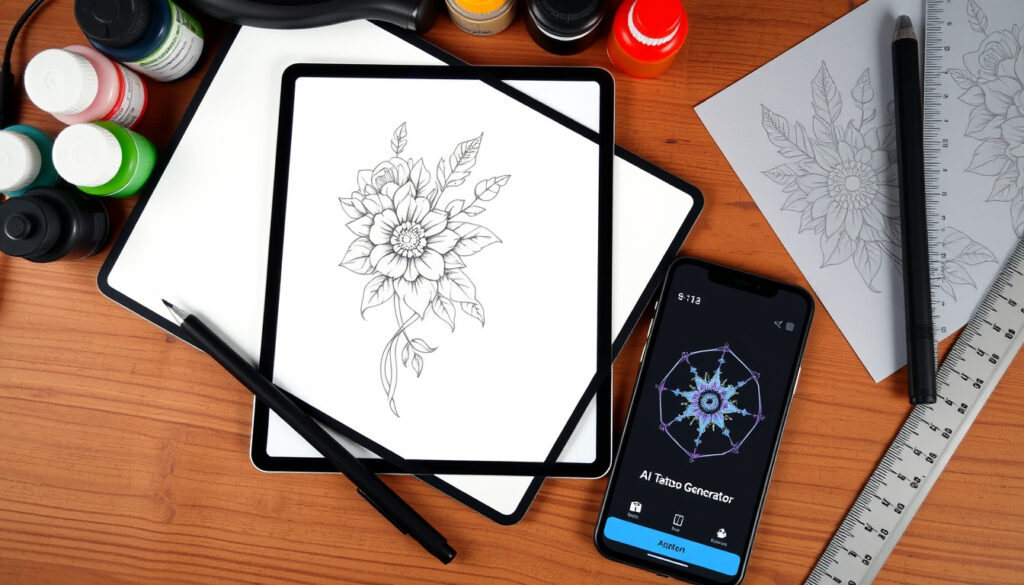
How to Design a Tattoo: Free Apps, AI Generators & Rules
You’ve probably seen the Pinterest boards and Reddit threads — tattoo ideas by the hundreds, but how do you turn that inspiration into a design you’ll actually love? The good news is that free tools and AI generators now make it possible to create a custom tattoo concept without spending a dime on a designer.
Free tattoo design apps on Google Play: Over 50 as of 2024 ·
AI-generated tattoo designs created daily: Estimated millions ·
Tattoo regret rate among adults: 23% (Harris Poll, 2022) ·
Average cost of a custom tattoo design: $50-$200 per hour
Quick snapshot
- Canva AI Tattoo Generator (free) Canva
- Tat Ink (free, multiple styles) Tat.ink
- Tattoo AI on Google Play (free) Google Play
- 1/3 rule for composition Evolve Tattoo Collective
- Balance contrast and negative space AI for Tattoo
- Match design to body curvature (Evolve Tattoo Collective)
- Trendy fads (e.g., micro-realism stars) AI for Tattoo
- Poorly placed hand designs AI for Tattoo
- Tiny text that blurs over time AI for Tattoo
Here are key facts about tattoo design you should consider before starting.
| Fact | Detail |
|---|---|
| Rule of thirds for tattoos | A composition technique dividing the canvas into a 3×3 grid |
| Number of free tattoo design apps | Over 50 on Google Play (2024) |
| Tattoo regret percentage | 23% (Harris Poll, 2022) |
| Common 333 tattoo meaning for girls | Often related to angel number symbolism (growth, support) |
Is there a free app to design a tattoo?
Yes — plenty of free tools let you experiment with tattoo designs without spending a cent. The challenge is finding one that produces actual artwork you’d want permanently on your skin.
Free AI tattoo generators (Canva, Tat Ink)
- Canva’s AI Tattoo Generator is free and lets you describe a tattoo idea in text, then generates multiple visual concepts Canva (AI design platform).
- Tat Ink offers a free AI generator that produces designs in various styles, from traditional to neo-tribal Tat.ink (dedicated tattoo AI tool).
- Meta AI has a public page dedicated to AI for tattoo design, signaling that this is now a mainstream consumer use case Meta AI (consumer AI research).
Free mobile tattoo design apps
- Google Play lists over 50 free tattoo design apps as of 2024, including Tattoo AI and InkHunter Google Play Store.
- Most allow you to upload a photo of your body part and try on designs using augmented reality.
Limitations of free tattoo design apps
- Free apps often add watermarks or limit the number of styles available.
- AI-generated designs may lack the structural integrity needed for a real tattoo — lines can be too thin, details too tight for skin (AI for Tattoo optimization guide).
- You cannot copyright AI-generated designs, so a tattoo artist may refuse to tattoo them without modifications.
Free apps give you quantity over quality. Generating 5–10 variations per idea is smart — but exporting the best 2–3 for a professional artist consultation is the real step that saves you from regret Aussie Focus Hub (AI tattoo guide).
The implication: rely on free tools for exploration, not for final decisions.
What is the 1/3 rule tattoo design?
The 1/3 rule is a composition guideline borrowed from photography and visual arts, adapted for tattoo design. It helps create balance between ink, color, and open skin.
How the 1/3 rule applies to composition
- Some tattoo artists use the 1/3 rule to mean a tonal balance of roughly one-third black, one-third midtones, and one-third light/open skin in black-and-gray work Charles Huurman (tattoo philosophy video).
- Another interpretation splits the design into one-third color, one-third black work, and one-third empty skin space Evolve Tattoo Collective (tattoo education blog).
- The rule prevents the tattoo from looking too “heavy” or too sparse, giving it a professional finish.
Using the 1/3 rule for placement on arm or leg
- When placing a design, imagine a 3×3 grid over the body area. The focal point should sit at one of the four intersections, not dead center (Aussie Focus Hub placement guide).
- This creates a dynamic, eye-catching layout that works with the body’s natural curves.
- Using a quick rule-of-thirds overlay on a tablet can help you experiment with placements before committing (AI for Tattoo composition elements).
Examples of tattoo designs following the 1/3 rule
- American Traditional tattoos often use the 1/3 rule as a boldness and legibility guideline — heavy black, saturated color, and open skin in equal thirds Environmental Literacy (tattoo rule explainer).
- A floral forearm piece might place the main flower at the top-left intersection, with leaves filling the bottom-right and negative space framing the rest.
The implication: the 1/3 rule isn’t a strict formula, but a tool to stop you from overloading a design. The most effective tattoos use it unconsciously.
How can I design a tattoo I want?
Designing a tattoo you’ll love for decades involves a structured process, not just a single Pinterest search. Follow these steps:
- Gather inspiration from social media (Pinterest, Reddit)
- Use AI tools to generate design concepts
- Work with a tattoo artist or designer
- Refine your idea into a final design
Gathering inspiration from social media (Pinterest, Reddit)
- Collect 20–30 reference images before you even open a design tool (Aussie Focus Hub reference gathering).
- Reddit’s r/TattooDesigns and Pinterest boards are top sources for real-world examples and discussions.
- Look for designs that share a consistent style, subject, or placement — this will define your direction.
Using AI tools to generate design concepts
- Describe your vision in a text prompt: “neo-traditional floral armband with black and red, 1/3 rule composition.”
- Generate 5–10 variations and export the best 2–3 for your artist consultation (Aussie Focus Hub AI workflow).
- Before generating, define placement, final size, and dominant technique — this prevents unusable outputs (AI for Tattoo optimization).
Working with a tattoo artist or designer
- Most professional artists will redraw an AI concept into a tattoo-ready design, adjusting line weights and shading for skin.
- Bring your 2–3 best AI outputs plus your reference board to the consultation.
- A good artist will explain why some elements won’t work — for example, tiny details that will blur over time.
Refining your idea into a final design
- Don’t rush. Take the artist’s feedback and run it back through the AI tool for a second round of refinement.
- Use negative space to frame the subject and avoid crowding high-movement zones like the armpit or elbow (AI for Tattoo composition landmarks).
- Finalize with a clear yes/no — if you’re unsure, wait another month.
A common mistake: designing a tattoo on a flat screen and then placing it on a curved body part. Always simulate the design on a photo of your actual arm or leg using an AR app before committing.
What is a good tattoo design?
A good design is one that ages well, fits your body’s contours, and communicates meaning clearly. Here are the three pillars.
Elements of a high-quality tattoo design
- Clear lines, high contrast, and intentional composition — the 60/30/10 breakdown of supportive shapes, main forms, and high-contrast accents (AI for Tattoo balance & structure).
- Good use of negative space prevents the tattoo from looking like a muddy blob.
- A design should be readable from a few feet away — if you need to squint, it’s too detailed.
Matching design to body placement
- Placement affects how the design ages. High-movement areas (hands, elbows, ankles) cause faster fading and blurring.
- Flat areas like the shoulder blade or chest are ideal for intricate designs; curved areas like the forearm suit flowing, organic shapes.
- Use the rule of thirds to place the focal point at an intersection for a natural look (AI for Tattoo placement guide).
Avoiding trendy designs that age poorly
- Micro-realism stars, tiny text, and watercolor techniques without black outlines often fade or blur within a few years.
- Classic styles like American Traditional, Japanese, and neo-traditional have proven longevity.
- If you’re drawn to a trend, ask your artist: “How will this look in 10 years?”
The pattern: the best designs are timeless, not trendy. If you’re attracted to a design because it’s popular on Instagram, give it a six-month cooling-off period.
Can ChatGPT design tattoos?
ChatGPT can help you brainstorm and refine tattoo ideas, but it cannot generate visual images natively. It’s a textual assistant, not a design tool.
How ChatGPT can generate tattoo ideas
- You can describe a concept and ask for theme variations, symbolic meanings, or placement suggestions.
- For example: “Suggest five tattoo concepts for a tribute to a parent using a compass and a bird.”
- ChatGPT can also help you write a detailed prompt for an AI image generator like Canva or DALL·E.
Limitations of ChatGPT for tattoo design
- It cannot produce a visual mockup or check composition rules like the 1/3 rule.
- The output is text-only — you’ll need a separate image generator to see the idea.
- ChatGPT doesn’t understand tattoo-specific constraints like skin aging, needle depth, or color fade.
Better alternatives for visual design output
- Use Canva AI Tattoo Generator or Tat Ink for actual visuals.
- Meta AI also offers a tattoo design feature that generates images from text prompts Meta AI (tattoo design).
- For a fully custom design, nothing beats a human artist — AI is a tool, not a replacement.
“The 1/3 rule in tattooing is about balance — one-third black, one-third midtones, one-third open skin. It’s the difference between a tattoo that looks like a sticker and one that looks like it belongs on your body.”
Charles Huurman (professional tattoo artist, Talking Tattoo Philosophies)
“AI for tattoo design is now a mainstream consumer use case — anyone can generate a custom tattoo concept in seconds, but the real art is in the adaptation for skin.”
For the 23% of adults who regret a tattoo (Harris Poll, 2022), the root cause is often a design that was chosen on impulse or through a single filter. The remedy is a deliberate process: gather references, use AI tools to explore, apply the 1/3 rule for balance, and always consult a professional before inking. For anyone considering a first tattoo, the choice is clear: invest time in the design phase, or risk spending money on laser removal later.
youtube.com, aussiefocushub.net, reddit.com, youtube.com, youtube.com, sunlineinsight.com, dailycity.co.uk
For a deeper dive into how symbols and composition rules work together, check out this tattoo design guide with symbol meanings that expands on the 1/3 rule and cultural meanings.
Frequently asked questions
What is the best font for tiny tattoo text?
Sans-serif fonts like Arial or Helvetica in at least 10pt are recommended for legibility. Script fonts and fonts with thin strokes tend to blur or fade faster.
How much do custom tattoo designs usually cost?
Most artists charge between $50 and $200 per hour for custom design and tattooing. A small custom design may cost $100–$300, while large sleeves can run $1,000–$3,000 total.
Can I use a photo as a tattoo design?
Yes, but a photo must be converted into a tattoo-friendly design by an artist. Avoid direct photo tattoos because they often lack contrast and age poorly.
What does a 333 tattoo symbol mean for girls?
The 333 tattoo is often associated with angel number symbolism, representing growth, support, and encouragement from the universe. It’s a popular choice for women seeking a meaningful small design.
How do I choose a tattoo design that will age well?
Choose a design with clear outlines, high contrast, and a classic style. Avoid tiny details, thin lines, and light colors that fade quickly. Consult your artist about placement and size.
Is it safe to use an AI generator for my first tattoo design?
AI generators are safe for brainstorming, but never take an AI-generated image directly to a tattoo artist without review. AI can produce designs that are unworkable on skin — always have a professional artist adapt it.
Related reading
- Tattoo Composition Landmarks: How to Design a Well-Placed Tattoo — detailed guide on placement using the rule of thirds.
- Tattoo Composition Elements: Balance and Structure — deep dive into the 60/30/10 breakdown and other design principles.
More related posts
 Alisson Becker: Age, Height, Wife, Contract, Goals, Injury
 Christina Koch: Astronaut, Record-Setter, Personal Life Facts
 Caspar Jopling: Age, Height, Relationships & Royal Ties
 Bruno Tonioli Britain’s Got Talent Judge: Exit & Net Worth
 ADHD Medication: Types, Side Effects & How to Get It
 BT Email Login UK: How to Sign In, Recover & Keep Your Account
 Viktor Gyökeres Stats, Height, and Arsenal Profile
 Thomas Tuchel: Wife Split, Salary, England Job & Career Timeline
