Guy Fawkes: Gunpowder Plot, Bonfire Night & Legacy
Every November 5, bonfires light up British skies, but the man whose effigy burns on them has taken on a second life far from those flames. Guy Fawkes was a Catholic conspirator caught red-handed with 36 barrels of gunpowder under the Houses of Parliament, yet today his masked face is a global symbol of rebellion — a journey from failed regicide to state holiday to protest icon.
Born: 1570, York, England · Died: January 31, 1606, London · Plot date: November 5, 1605 · Conspirators: 13 men · Gunpowder barrels: 36 · Annual commemoration: Guy Fawkes Night, November 5
Quick snapshot
- Guy Fawkes was a member of the Gunpowder Plot aimed at killing King James I (Origins: Current Events in Historical Perspective (academic history journal))
- He was arrested on 5 November 1605 guarding explosives under the House of Lords (Origins)
- He was executed by hanging, drawing, and quartering on 31 January 1606 (BBC Teach (UK educational broadcaster))
- The exact identity of the person who wrote the warning letter to Lord Monteagle remains uncertain (BBC Teach)
- Whether Fawkes intentionally jumped from the scaffold to break his neck is debated (English Heritage (UK heritage authority))
- 1570 – Fawkes born in York (BBC Teach)
- 5 November 1605 – Fawkes discovered in the cellar (BBC Teach) (BBC Teach)
- 31 January 1606 – Execution (BBC Teach) (BBC Teach)
- 2005 – V for Vendetta film popularises the mask as a protest symbol (Work Rights Centre (UK social justice charity))
- Bonfire Night continues to be celebrated annually on 5 November across Britain (English Heritage)
- The Guy Fawkes mask remains a tool for protest anonymity, especially with Anonymous (ABC News (US news network))
The table below maps the key facts of Guy Fawkes’s life, showing how a single night shaped British memory.
| Label | Value |
|---|---|
| Full name | Guy Fawkes (also known as Guido Fawkes) |
| Birth | 1570, York, England |
| Death | January 31, 1606, London |
| Role in plot | Explosives expert, placed the gunpowder |
| Fate | Executed by hanging, drawing, and quartering |
| Annual commemoration | Guy Fawkes Night, November 5 |
What did Guy Fawkes do and why?
The Gunpowder Plot of 1605
- Guy Fawkes was a member of a group of provincial English Catholics who planned to assassinate King James I (Royal Museums Greenwich (national maritime museum))
- The plot aimed to blow up the House of Lords during the State Opening of Parliament on 5 November 1605 (Origins: Current Events in Historical Perspective)
- The conspirators sought to restore a Catholic monarch by triggering a Catholic uprising after the king’s death (Origins)
Motivations of the conspirators
The plotters, led by Robert Catesby, were reacting to the harsh anti‑Catholic laws under James I. They believed that removing the Protestant king would allow a Catholic succession. Fawkes, who had fought for Spain in the Eighty Years’ War, was recruited for his explosives expertise. The 36 barrels of gunpowder they stockpiled — enough to destroy the entire chamber — reflected the scale of their desperation.
The implication: the plot was not a lone madman’s act but a calculated political strike by a network of English Catholics who saw violence as their last resort.
Why do we still celebrate Guy Fawkes?
Origins of Bonfire Night
The Observance of 5th November Act 1606 mandated an annual public thanksgiving for the plot’s failure (BBC Teach). Londoners lit celebratory bonfires, and the tradition spread. The Act was in force until 1859, but the custom endured.
- Bonfires and fireworks commemorate the plot’s failure, not its perpetrators (English Heritage)
- The first remembrance was a state‑sanctioned anti‑Catholic celebration of King James’s survival (Royal Museums Greenwich)
Modern celebrations
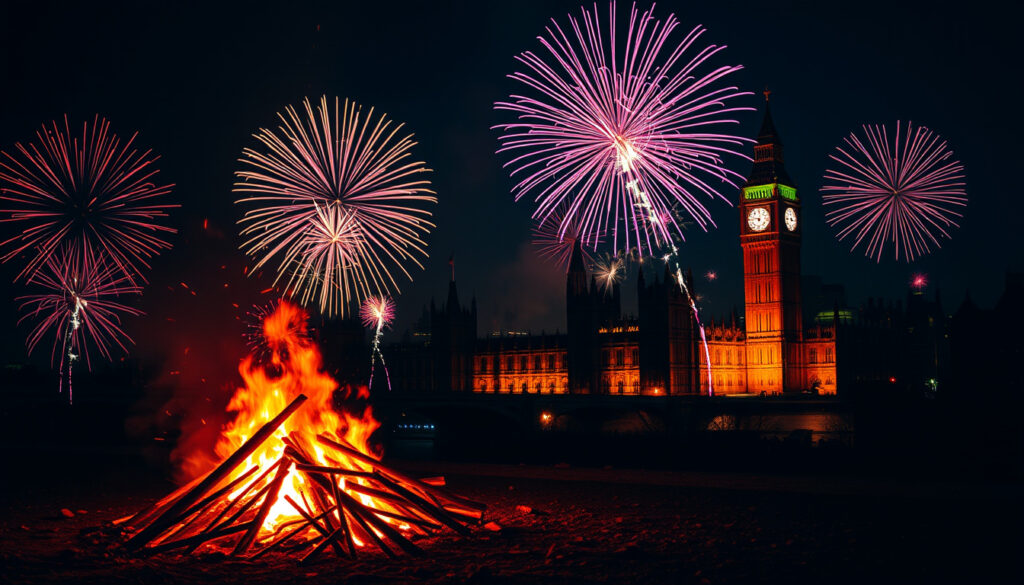
Guy Fawkes Night is celebrated across Britain with bonfires, fireworks, and the burning of an effigy of Fawkes. What began as a religiously charged commemoration has become a secular community event. Children once asked “Penny for the Guy” on the streets, though that practice has faded.
A plot to kill a king became a family‑friendly firework night — the original political meaning has been largely scrubbed from the celebration, except in the effigy that still burns.
Why this matters: the very act meant to reinforce anti‑Catholic sentiment now coexists with a more inclusive, commercialised tradition, showing how state rituals can outlive their original intent.
Was Guy Fawkes a hero or a villain?
Historical perspective
Contemporary accounts condemned the plot as treason. King James I called the plotters “pestilent” and “savage beasts.” The government used the plot to justify further restrictions on Catholics. Fawkes was portrayed as the devilish face of Catholic treachery.
- The official narrative cemented Fawkes as a villain in British collective memory (Royal Museums Greenwich)
- Some later narratives, especially among Catholic sympathisers, reframed him as a freedom fighter willing to die for his faith
Modern reinterpretation as a symbol of protest
The Guy Fawkes mask became a global protest symbol after the 2005 film V for Vendetta (Work Rights Centre). The hacktivist group Anonymous adopted it, and it now appears at protests from Hong Kong to the United States.
The trade‑off: the same face that once represented a Catholic terrorist now stands for anti‑authoritarian dissent — an irony that would have shocked the 17th‑century state that burned his effigy.
How did Guy Fawkes die?
Capture and interrogation
Fawkes was arrested on November 5, 1605, shortly after midnight, when guards found him in the cellar with the explosives (Origins). He was taken to the Tower of London and tortured, eventually signing a confession.
- He identified himself as John Johnson before revealing his true name under torture (BBC Teach)
- His trial took place on January 27, 1606, where he and seven surviving conspirators were found guilty of high treason
Execution
Fawkes was sentenced to be hanged, drawn and quartered. On January 31, 1606, at Westminster, he mounted the scaffold. Accounts differ on his final act: some say he jumped voluntarily from the scaffold and broke his neck, dying instantly; others maintain he fell accidentally (English Heritage).
The uncertainty around his final jump means that even his death — arguably the one event where agency should be clear — remains a point of historical ambiguity. For believers in his heroism, a voluntary leap is a final act of defiance.
The catch: whether by intention or accident, Fawkes avoided the worst of the hanging‑drawing‑and‑quartering penalty, which his co‑conspirators all suffered in full.
Who snitched on Guy Fawkes?
The anonymous letter
A letter warning Lord Monteagle not to attend Parliament on November 5 was delivered on October 26, 1605 (BBC Teach). It read: “They shall receive a terrible blow at this Parliament.” Monteagle, a Catholic lord who had once been a conspirator himself in the Essex Rebellion, passed the letter to the government.
- The letter was shown to King James I, who ordered a search of the cellars (BBC Teach)
- The identity of the writer remains uncertain, though it is often attributed to one of the conspirators — possibly Francis Tresham, who was related to Monteagle by marriage
Lord Monteagle’s warning
Monteagle’s role is itself suspicious: a former Catholic rebel who now sat in the House of Lords. Some historians suggest he was tipped off by a relative. What is clear is that without that letter, the plot might have succeeded.
The pattern: a single piece of paper — source still unknown — collapsed a conspiracy that had taken months to build, reshaping English history and creating a holiday that persists over 400 years later.
Timeline
- – Guy Fawkes born in York, England
- – Gunpowder Plot conceived; Fawkes recruited
- – Anonymous letter warns Lord Monteagle
- – Fawkes discovered and arrested
- – Trial of the conspirators
- – Fawkes executed
- – Observance of 5th November Act passed
- – V for Vendetta popularises the Fawkes mask as a protest symbol
Clarity check
Confirmed facts
- Guy Fawkes was a member of the Gunpowder Plot targeting King James I
- He was arrested on 5 November 1605 in the cellar under the House of Lords
- He was executed on 31 January 1606
- The Guy Fawkes mask is now a global protest symbol linked to Anonymous
What’s unclear
- The exact identity of the person who wrote the Monteagle warning letter
- Whether Fawkes intentionally jumped from the scaffold to break his neck
- Bonfire Night has been observed annually since 1606 – the exact continuity of the early observances is debated
Quotes from history
When asked why he had so much gunpowder, Fawkes reportedly said he intended to blow the Scottish beggars back to Scotland.
– Guy Fawkes (under torture), as recorded in contemporary accounts
Let us all join in thanking God for delivering us from this horrible treason, and let us ever remember that the safety of the kingdom depends on the watchfulness of good men.
– King James I, speech to Parliament, 1605 (paraphrased from historical record)
It was the luckiest break the government ever had – and it gave them an excuse to crack down on Catholics for centuries.
– Historic Royal Palaces (UK heritage charity), official account of the plot
For modern Britons, the choice is clear: keep the bonfires and fireworks as a secular tradition, or confront the anti‑Catholic origins that linger under the flames. The effigy burns either way — but what it means depends on who is watching.
bbc.com, en.wikipedia.org, hilobrow.com, worldremit.com, youtube.com, en.wikipedia.org, eldiariopunto.es
For a deeper look into the Gunpowder Plot’s history, the Gunpowder Plots history provides a comprehensive account of the events leading up to the failed assassination attempt.
Frequently asked questions
What was the Gunpowder Plot?
A failed conspiracy by 13 English Catholics to blow up the House of Lords and kill King James I on 5 November 1605, aiming to restore a Catholic monarch.
Why did the conspirators want to blow up Parliament?
They hoped that by killing the Protestant king and his government, a Catholic uprising would succeed and place a Catholic ruler on the throne.
How much gunpowder did Guy Fawkes use?
The conspirators stored 36 barrels of gunpowder under the House of Lords — enough to destroy the entire building.
What happened to the other conspirators?
Eight surviving plotters were captured, tried for high treason, and executed by hanging, drawing, and quartering in January 1606.
Is Guy Fawkes Night the same as Bonfire Night?
Yes — both refer to the annual celebration on 5 November, featuring bonfires, fireworks, and sometimes the burning of an effigy of Guy Fawkes.
Why do people burn an effigy of Guy Fawkes?
The tradition began as a symbolic punishment of the traitor, reinforcing the state’s victory over Catholic rebellion.
What does the Guy Fawkes mask represent today?
It has become an international symbol of protest anonymity, popularised by the film V for Vendetta and used by groups like Anonymous.
More related posts
 Mukesh Ambani Net Worth: How He Built $91.8B
 How Much Is National Insurance – UK Rates and Thresholds 2024/25
 Make Money From Home – Legit UK Side Hustles and Guides
 Gervonta Davis Record, Next Fight, and Net Worth: Is Tank Still Undefeated
 Lorenzo Musetti: Career, Family, Net Worth & Arm Sleeve
 Best Time to Post on Instagram – Data-Driven Peak Hours
 Lewis Pullman: Actor, Nepo Baby? Age, Net Worth & More
 Jeff Nippard: Biography, Natty Status, Return After Loss
