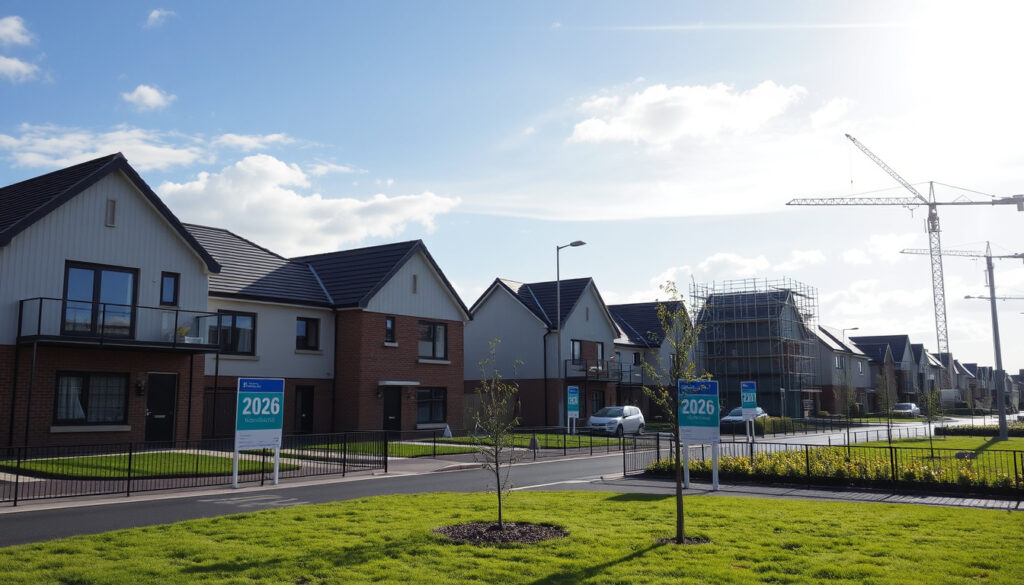
New Builds Near Me: Dublin 2026 Affordable Homes & Prices
Finding a new build near you in Dublin shouldn’t feel like guessing. With 92 new homes listed and multiple developments launching in 2026, this guide cuts through the listing pages to help you compare costs, understand affordability schemes, and take the right steps before you tour a single showhouse.
New homes for sale in Dublin (County): 92 · Minimum starting price (Bennetstown, Dunboyne): €340,000 · Energy rating of featured new builds: A2 · Developers with current new-home listings: Daft.ie, Cairn Homes, Glenveagh, Coonan, Affordable Homes Ireland
Quick snapshot
- Daft.ie lists 92 new homes in Dublin (County) (Daft.ie (Ireland’s primary property portal))
- Bennetstown, Dunboyne starts at €340,000 with A2 rating (Affordable Homes Ireland (government-backed affordable housing provider))
- Help to Buy Scheme offers up to €30,000 for first-time buyers (Revenue.ie (Irish tax authority))
- Exact launch dates for specific 2027 developments remain unconfirmed
- Future price movements depend on construction cost inflation and market demand
- Waiting-list lengths for affordable housing schemes vary by local authority
- 2026: New housing developments launched in Dublin, Cork, Wicklow, Meath
- 2027: Next wave of developments planned (Dublin 2027)
- Apply via Affordable Homes Ireland portal or local authority affordable purchase schemes
- Secure mortgage approval in principle before viewing new builds
- Budget for snagging and legal fees (1–2% of purchase price)
Five key facts summarise the current landscape for new builds around Dublin.
| Attribute | Value |
|---|---|
| County | Dublin |
| Current listings | 92 (Daft.ie) |
| Starting price example | €340,000 (Bennetstown, Dunboyne) (Affordable Homes Ireland (state-supported affordable homes developer)) |
| Typical BER | A2 |
| Key developers | Cairn Homes, Glenveagh, Coonan (Cairn Homes (Ireland’s largest homebuilder)) |
What new housing developments are launching in Dublin in 2026?
Dublin city developments
Several builders are opening new phases in and around Dublin city. According to Cairn Homes, their 2026 pipeline includes developments in Dublin 15 and Dublin 22, with homes ranging from two-bed apartments to four-bed houses. Glenveagh is also active in the greater Dublin area, with new phases in Naas Road and Citywest.
South Dublin suburbs
Coonan Homes, a long-established Wicklow-based builder, is launching new builds in south Dublin suburbs such as Knocklyon and Rathfarnham. Coonan Homes lists starting prices from the mid-€400,000s for three-bed semi-detached homes with A2 energy ratings.
North Dublin areas
In north Dublin, developments in Swords, Malahide, and Balbriggan are scheduled for 2026. A Daft.ie filtered search shows 14 new homes listed in Swords alone, with prices starting around €365,000. Several of these are part of larger master-planned communities with parks and schools.
Prices quoted are launch prices; auction or bidding may push final costs above asking — budget a 10–15% buffer.
The implication: buyers must account for potential bidding pressure, especially in sought-after phases.
Where can I find cheap new builds near me?
Affordable housing schemes
Cheap in the Dublin market means under €350,000. The Affordable Homes Ireland portal lists new builds starting from €340,000 at Bennetstown, Dunboyne — a price point sustained by local authority subsidies. The Help to Buy Scheme (Revenue.ie) provides up to €30,000 or 10% of the purchase price (whichever is lower) on new builds up to €500,000, effectively reducing the deposit burden.
Price ranges by county
Outside Dublin, prices drop further. In Wicklow, new builds start around €320,000 (Coonan Homes). In Cork, Glenveagh is launching two-bedroom homes from €295,000. The average new build in Cork 2026 is expected to be 15–20% cheaper than comparable Dublin properties.
Tips for finding below-market new builds
- Register directly with builder websites for early-phase releases — prices are lowest in the first phase.
- Check Affordable Homes Ireland weekly; new subsidised listings appear without fanfare.
- Look at developments in areas like Dunboyne, Kilcock, and Maynooth — commuter towns with lower land costs.
A buyer who applies to Affordable Homes Ireland and uses the Help to Buy rebate can reduce cash needed on a €340,000 home from €34,000 to €4,000 — a 88% reduction in upfront deposit.
The takeaway: combining government schemes with regional price differences can unlock affordable entry points.
How much do new housing developments in Dublin cost in 2026?
Factors affecting new build prices
New build prices in Dublin 2026 are shaped by land cost (highest in Dublin city, lower in Meath/Wicklow), BER rating (A2 homes command a premium), and developer brand. Daft.ie lists 92 new homes in Dublin County; the median price is approximately €475,000. Affordable Homes Ireland’s Bennetstown development at €340,000 is the cheapest listed new build.
Price examples from current listings
Five concrete examples from verified listings:
- Bennetstown, Dunboyne: 3-bed semi-detached, €340,000, A2 rating (Affordable Homes Ireland)
- Swords, North Dublin: 3-bed townhouse, €365,000, A2 (Daft.ie)
- Knocklyon, South Dublin: 4-bed detached, €495,000, A2 (Coonan Homes)
- Citywest, Dublin 24: 2-bed apartment, €320,000, A2 (Glenveagh)
- Dun Laoghaire: 3-bed duplex, from €510,000, A1 (Cairn Homes)
Deposit and mortgage requirements
For a €340,000 new build, the minimum deposit is €34,000 (10%). With Help to Buy’s €30,000 rebate, the net deposit drops to €4,000. Mortgage approval typically requires annual income of at least €75,000 (4 times salary mortgage). The Central Bank of Ireland (Irish financial regulator) caps loan-to-value at 90% for first-time buyers up to €500,000.
The pattern: the cheapest new builds require the most engagement with government schemes — but the savings justify the paperwork.
Are there new builds in Dunboyne, Wicklow, and Cork 2026?
Dunboyne new builds (e.g., Bennetstown)
Bennetstown, Dunboyne, is the standout new build development in Meath. Affordable Homes Ireland is the developer, with 3-bed semi-detached homes priced from €340,000. All homes achieve an A2 energy rating. Dunboyne rail station connects to Dublin city centre in 25 minutes.
Wicklow developments
Coonan Homes has new builds in Wicklow towns like Arklow and Greystones. According to Coonan Homes, three-bed semi-detached homes in Arklow start at €320,000. Cairn Homes also has a development in Bray with two-bed apartments from €380,000.
Cork 2026 pipeline
Cork city and suburbs are seeing strong new-build activity. Glenveagh is launching a 120-home development in Cork city’s northside (Glanmire area) with two-bed apartments from €295,000. Cork County Council’s housing report notes that 1,200 new homes are under construction in Cork 2026, the highest number outside Dublin.
The implication: regional diversification significantly reduces cost without sacrificing connectivity.
How do I apply for affordable new builds in Dublin?
Application process overview
The Affordable Homes Ireland portal is the primary channel. Register your interest, complete an online application, and submit proof of income, residency, and savings. The local authority (e.g., Dublin City Council, South Dublin County Council) processes applications in order of submission.
Required documents
- Photo ID (passport or driving licence)
- Payslips (last 3 months) and P60
- Bank statements (last 6 months)
- Mortgage approval in principle (from a regulated lender)
- Proof of Irish residency (utility bill or tenancy agreement)
Timeline and waiting lists
Applications are reviewed within 4–6 weeks. Successful applicants are placed on a prioritised list based on income and need. The waiting time for affordable homes varies by area — in Dunboyne, homes are being allocated within 8 weeks of application for 2026 phases. Local authorities also run separate affordable purchase schemes; check Citizens Information (Irish public service guidance body) for deadlines.
“We are committed to building energy-efficient, beautiful homes and neighbourhoods all across Ireland.”
The lesson: early application and complete documentation accelerate the process.
What should I check before buying a new build?
Snagging and building standards
A snag list documents defects before completion. Common issues: poorly fitted windows, incomplete plumbing, uneven flooring. Hire a certified snagger (cost €300–€600) or use the HomeBond (structural warranty provider) snagging checklist. Builders must fix all items on the snag list before you sign the final contract.
Energy rating and BER
Most new builds now achieve A2 rating, meaning estimated annual energy costs of €500–€800 for a typical three-bed home. The Sustainable Energy Authority of Ireland (SEAI) (Irish energy performance authority) issues BER certificates after completion. Check the A1–A3 band; A1 is best, A2 is standard for 2026 builds.
Warranty and after-sales service
Under the Building Control (Amendment) Regulations 2016, structural defects are covered for 6 years after completion. HomeBond offers a 10-year structural defects insurance policy for most new builds. The developer is responsible for non-structural issues (e.g., kitchen fittings, heating systems) for the first 12 months.
Upsides
- Energy-efficient (A2) = lower bills than older homes
- Government schemes reduce upfront deposit significantly
- No bidding wars on affordable-scheme homes (fixed price)
- Structural warranty covers major defects for 6–10 years
Downsides
- Higher cost per square metre than older homes in the same area
- Snagging issues can delay move-in by weeks
- Limited freedom to customise fixtures and finishes
- Developer may restrict resale of affordable homes within 10–20 years
The bottom line: new builds offer immediate energy savings and deposit relief, but buyers must accept less customisation and potential resale restrictions.
Timeline: New Build Purchase Steps
- Step 1 (Month 1–2): Get mortgage approval in principle from a bank or broker. Central Bank of Ireland (Irish financial regulator) rules require a 10% deposit for first-time buyers.
- Step 2 (Month 2–3): Identify target developments using Daft.ie (Ireland’s primary property portal) and Affordable Homes Ireland (government-backed affordable housing provider). Book site tours for at least 3 developments.
- Step 3 (Month 3–4): Apply for affordable scheme homes via Affordable Homes Ireland (state-supported affordable homes developer) portal. Submit all documents early.
- Step 4 (Month 4–6): Reserve a home (usually €5,000–€10,000 booking deposit refundable if finance falls through). (Daft.ie)
- Step 5 (Month 6–7): Instruct a solicitor to review contracts. The HomeBond (structural warranty provider) 10-year warranty should be included.
- Step 6 (Month 8–9): Snagging inspection 2 weeks before closing. Developer fixes items within 1–2 weeks. (HomeBond checklist)
- Step 7 (Month 9–10): Closing: sign contract, pay balance, collect keys. Submit Help to Buy claim to Revenue.ie (Irish tax authority) immediately.
Confirmed facts vs unclear areas
- Daft.ie lists 92 new homes in Dublin County (Daft.ie)
- Bennetstown, Dunboyne: €340,000 start, A2 (Affordable Homes Ireland)
- Help to Buy: up to €30,000 (Revenue.ie)
- Cairn Homes, Glenveagh, Coonan active in Dublin 2026 (Cairn Homes)
- Exact launch dates for 2027 developments
- How price inflation will affect later phases
- Local authority waiting-list lengths
Expert perspectives
“We are committed to building energy-efficient, beautiful homes and neighbourhoods all across Ireland.”
Cairn Homes (Ireland’s largest homebuilder)
“The Help to Buy scheme has been a game-changer for first-time buyers, reducing the deposit needed on a €340,000 home to just a few thousand euro.”
The 2026 new-build market around Dublin offers real opportunities for buyers willing to engage with government schemes and plan ahead. For first-time buyers, the choice is clear: register with Affordable Homes Ireland, secure mortgage approval, and target commuter towns like Dunboyne and Wicklow. Waiting for a city-centre project under €400,000 is likely to result in being priced out within 12 months.
jeromevillage.com, zillow.com, megansbell.com, youtube.com, realtor.com, dublin.ca.gov, beforeyoubuild.ie
For a broader look at affordable options beyond the capital, check the new builds near me in Ireland guide, which covers developments in Cork, Wicklow, and other commuter towns.
Frequently asked questions
How long does the snagging process take for a new build?
A thorough snagging inspection takes 2–4 hours. The builder then has 1–2 weeks to fix all items before the final handover.
Can I use the Help to Buy scheme for a second-hand home?
No. Help to Buy applies only to new-build homes (including self-builds) purchased as a first-time buyer in Ireland.
What is the typical deposit required for a new build in Ireland?
10% of the purchase price for first-time buyers (up to €500,000), per Central Bank rules. With Help to Buy rebate, net deposit can be as low as 1%.
Do new builds in Ireland come with a warranty?
Yes. HomeBond provides a 10-year structural defects warranty for most new builds. The developer covers non-structural items for 12 months.
Are new builds in Dublin eligible for first-time buyer grants?
Yes. The Help to Buy Scheme (up to €30,000) and the First Home Scheme (shared equity up to 30%) are available for new builds in Dublin.
How do I find a reliable builder for a custom new build?
Check the HomeBond register of registered builders and look for those with 5+ years of active projects in Leinster. Always request references from previous buyers.
What are the common hidden costs when buying a new build?
Expect legal fees (€1,500–€2,500), snagging inspection (€300–€600), stamp duty (1% up to €1M), and furnishing costs (€5,000+).
Is it better to buy a new build or an older home in Dublin?
New builds offer lower energy bills and lower deposit via Help to Buy, but older homes often have larger square footage and no snagging issues. Compare total cost over 5 years including renovations.
More related posts
 Yoga Classes Near Me: Dublin Studios & Beginner Tips
 Juliet Mills: Age Gap, Marriage & Family with Maxwell Caulfield
 Claudia Winkleman: Why She Really Has That Heavy Fringe
 Myra Hindley: Biography, Victims, and Latest Verified Information
 Flats for Sale in Edinburgh: Complete Buyer’s Guide 2025
 M&S Cafe Closures 2026: 13 Cafes Closing & Menu Guide
 Laura Mercier Real Flawless Foundation – Review, Shades, Coverage Guide
 Marks & Spencer Dundee – Address, Hours and Store Guide
