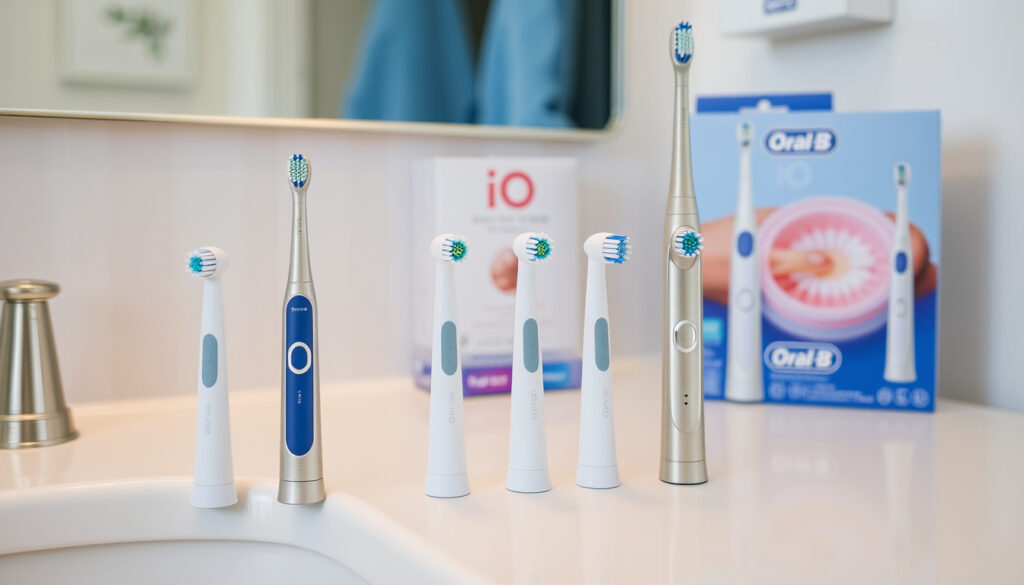
Oral-B iO Brush Heads: Compatibility & Selection Guide
Anyone who’s picked up an Oral‑B iO toothbrush for the first time probably noticed something right away: the brush head clicks on with an unusual magnetic snap, not the push‑and‑twist of older models because iO handles require their own dedicated heads, and with five different types on the market, picking the right one can feel like decoding a secret menu. This guide cuts through the confusion, explaining exactly which heads work with which handles, what makes genuine heads worth the price, and how to get the best clean for your teeth and gums.
Brush head types for iO: 5 main variants ·
Bristle count in iO Gentle Care: 4,000 soft bristles ·
Plaque removal improvement: Up to 100% more than a manual toothbrush ·
Compatibility: iO heads fit only iO handles ·
Price range (4‑pack): €20 – €40
Quick snapshot
- Oral‑B iO heads are designed exclusively for iO handles (Oral‑B – brand’s official guidance)
- Genuine iO heads feature rounded bristles and a cushioning ring (Oral‑B – compatibility page)
- Long‑term durability of generic iO heads vs genuine remains unverified by independent tests (TechAdvisor – independent tech reviewer)
- Whether all generic heads are safe for iO handles — some users report pressure sensor disruption (TechAdvisor – independent tech reviewer)
- iO Ultimate Clean plaque removal claim (up to 100% more than manual) is based on manufacturer’s own testing, not independent verification (Oral‑B – plaque removal claim)
- iO series introduced a new brush head fitting in 2020, incompatible with all earlier Oral‑B handles (YouTube – Oral‑B iO Series Explained)
- More iO head variants expected as the platform matures
- Generic competition is increasing – prices may drop, but performance trade‑offs remain
Generic iO heads may save you money upfront, but TechAdvisor (independent tech reviewer) found they can disrupt the pressure sensor and cause gum soreness due to firmer bristles — a classic case of penny‑wise, pound‑foolish.
Here are the key specifications for iO brush heads, sourced from the manufacturer and independent retailers.
| Specification | Value | Source |
|---|---|---|
| iO Gentle Care bristle count | 4,000 | Oral‑B |
| Plaque removal vs. manual | Up to 100% more | Oral‑B |
| Compatibility | Only iO handles (iO2–iO10) | Oral‑B |
| Brush head shape | Round | Oral‑B |
| Brand recommendation | #1 dentist‑recommended brand (Oral‑B claim) | Oral‑B website |
| Number of iO head types | 5 main variants | Oral‑B |
| Average price per genuine head (4‑pack) | €5 – €10 | Boots (Irish pharmacy retailer) |
| Generic head price per unit (e.g., Cremodul) | ~€2.75 | TechAdvisor |
Do all Oral‑B heads fit iO brushes?
Short answer: no. Oral‑B iO handles (iO2 through iO10) use a magnetic snap mechanism that is physically different from the push‑on snap of older Oral‑B models. This means none of the classic Oral‑B brush heads — CrossAction, FlossAction, Sensitive, or Precision Clean — will attach to an iO handle.
Why iO brushes require dedicated heads
- The iO fitting was introduced in 2020 with the iO series (YouTube – Oral‑B iO Series Explained).
- Inside the iO head is a small chip that communicates with the handle for real‑time brushing feedback — something older heads lack.
- Using a non‑iO head on an iO handle simply won’t lock in place; forcing it could damage the magnetic connector.
The implication: If you upgrade to an iO brush, you must buy iO‑specific heads. There is no backwards compatibility.
Which older Oral‑B heads are incompatible
- CrossAction, FlossAction, Sensitive, 3D White, and Precision Clean — all standard snap‑on heads — do not fit iO handles.
- Even Oral‑B’s own Power Tip and Dual Clean heads (from the Pulsonic era) won’t work.
- Oral‑B (compatibility page) clearly states: “Non‑iO Oral‑B brush heads are compatible with all Oral‑B electric toothbrush handles except iO and Pulsonic.”
“All iO brush heads are interchangeable with any iO handle (iO2–iO10) and cleaning modes.”
The pattern: the iO ecosystem is walled off from older Oral‑B products, so users must commit to iO‑specific heads from day one.
Which replacement brush head fits my Oral‑B toothbrush?
Five iO head types, each colour‑coded and labelled with “iO”. Matching them to your handle is straightforward if you know where to look.
How to locate your toothbrush model number
- Check the underside of the handle — most iO models have the series number embossed (e.g., iO Series 6, 8, 9).
- If you own an older handle (Vitality, Pro, Smart, Genius) without “iO” on the label, it uses standard snap‑on heads.
Compatibility chart for Oral‑B handles and heads
| Handle series | Head type required | Example heads |
|---|---|---|
| iO 2 – iO 10 | iO magnetic snap heads | iO Ultimate Clean, iO Gentle Care, iO Sensitive Clean |
| Vitality, Pro 500–1000 | Standard snap‑on heads | CrossAction, FlossAction, Sensitive |
| Smart, Genius, Triumph | Standard snap‑on heads | CrossAction, 3D White, Precision Clean |
| Pulsonic | Pulsonic specific | Pulsonic heads (discontinued) |
Why this matters: Buying the wrong head is the most common mistake. A €40 pack of CrossAction heads will be useless if you have an iO handle — check first.
Are genuine Oral‑B iO brush heads better than generic?
The price gap is tempting — generic iO heads can cost under €3 each vs. €5–10 for genuine. But the savings come with trade‑offs.
Key differences in bristle quality and design
- Genuine iO heads have precisely rounded bristles and a flexible cushioning ring that conforms to tooth curves (Oral‑B).
- TechAdvisor tested generic heads and found they have “firmer bristles with less give” — some users reported gum soreness (TechAdvisor – independent tech reviewer).
- Electric Teeth (dental product specialist) recommends genuine heads for optimal plaque removal and handle sensor functionality.
Here’s how the costs and performance compare side by side.
Price vs. performance trade‑offs
| Attribute | Genuine Oral‑B iO | Generic iO compatible |
|---|---|---|
| Average cost per head | €5 – €10 | €2 – €4 |
| Bristle tip rounding | Clinically rounded | Often unrounded |
| Pressure sensor compatibility | Works perfectly | May disrupt sensor |
| Noise level | Normal | Increased noise reported |
| Plaque removal efficacy | Up to 100% more than manual | Not clinically tested |
| Warranty coverage | 2‑year warranty | Often none |
The trade‑off: Generic heads save money upfront but may give a less effective clean and could interfere with the smart features that make iO worthwhile.
If you have sensitive gums or rely on the pressure sensor (which lights up when you brush too hard), generic heads may cause problems. TechAdvisor warns that generic heads “increase noise and disrupt pressure sensor” on iO brushes.
What are the different types of Oral‑B iO brush heads?
Five variants, each tuned for a different brushing need. Here’s how they stack up.
iO Ultimate Clean
- Tuft‑in‑tuft design with angled bristles for hard‑to‑reach areas (Oral‑B – head types).
- Removes up to 100% more plaque than a manual toothbrush (Oral‑B).
- Best for: everyday thorough cleaning.
iO Gentle Care
- Features up to 4,000 extra‑soft density filaments that adapt to tooth and gum curvature (Oral‑B).
- Cushioning outer ring protects sensitive gums.
- Best for: sensitive teeth, receding gums, post‑dental treatment.
Other iO variants (Sensitive Clean, Premium Clean, Whitening)
- iO Sensitive Clean: 4,000 soft bristles with rounded tips — similar to Gentle Care but with a slightly firmer centre.
- iO Premium Clean: Combines power bristles with polishing cup for stain removal.
- iO Whitening: Polishing cup designed to lift surface stains — not universally available in all markets.
The pattern: If you have normal teeth and gums, the Ultimate Clean is the workhorse. For sensitivity, Gentle Care or Sensitive Clean are the smarter picks. Whitening variants are best as an occasional boost, not a daily driver.
What is the difference between Oral‑B and iO heads?
“Oral‑B head” is the generic name for all replacement heads; “iO head” refers specifically to those designed for the iO series. The differences go beyond branding.
Attachment mechanism differences
- Standard Oral‑B heads use a simple push‑on snap mechanism — a plastic collar that clicks onto the handle.
- iO heads use a magnetic snap system — a metal plate inside the head connects magnetically to the handle. No plastic collar.
Technology and brush head performance
- iO heads contain an NFC chip that communicates with the handle to track pressure, speed, and brushing time (YouTube – Oral‑B iO Series Explained).
- Standard heads have no chip — they rely purely on the handle’s built‑in timer and pressure sensor (which only works mechanically).
- Electric Teeth notes that iO Ultimate Clean and Gentle Care are performance equivalents to non‑iO CrossAction and Sensitive heads, but the chip integration makes the iO versions smarter.
“Non‑iO Oral‑B brush heads are compatible with all Oral‑B electric toothbrush handles except iO and Pulsonic.”
— Oral‑B official compatibility statement
Upsides
- Genuine iO heads deliver clinically proven plaque removal
- Pressure sensor and smart features work as designed
- Softer bristles protect gums and enamel
- Warranty coverage included
Downsides
- Higher cost per head than generic alternatives
- Only compatible with iO handles (no backwards compatibility)
- Limited colour options for identification rings
- Recyclability still limited (check local schemes)
The catch: the better technology comes with a premium and a tie‑in to the iO platform, so weighing the total cost of ownership is essential.
How to choose the right Oral‑B iO brush head
- Identify your handle: Look for “iO” on the handle body and note the series number (e.g., iO 6). All iO handles use the same magnetic fitting.
- Assess your teeth and gums: If you have sensitivity or gum recession, pick the iO Gentle Care or iO Sensitive Clean. For normal brushing, iO Ultimate Clean is the all‑round best.
- Decide on genuine vs generic: Consider your budget and whether you rely on the smart features. If you want the full iO experience, stick with genuine.
- Check the colour‑coding: Each head type comes with a coloured ring to help you identify it. Ultimate Clean is usually blue, Gentle Care is green, etc.
- Buy from a trusted retailer: Purchase from Boots (Irish pharmacy retailer), Dunnes Stores (Irish grocery retailer), or directly from Oral‑B to avoid counterfeits.
- Replace every 3 months: Oral‑B recommends changing brush heads every 3 months — the bristles splay and lose efficacy. Some iO handles have a “replace head” reminder.
For most users in Ireland and the UK, the best balance is a genuine iO Ultimate Clean for daily use and a Gentle Care for sensitive periods. Buying a 4‑pack from Boots or Dunnes Stores gives you a solid price per head and avoids the sensor issues of cheap generics.
Confirmed facts
- iO heads only fit iO handles (Oral‑B)
- Genuine heads have clinically proven plaque removal (up to 100% more than manual) (Oral‑B)
- There are 5 iO head types: Ultimate Clean, Gentle Care, Sensitive Clean, Premium Clean, Whitening (Oral‑B)
- Non‑iO standard heads (CrossAction, etc.) do not fit iO handles (Oral‑B)
- Generic heads can disrupt pressure sensor and increase noise (TechAdvisor)
What’s unclear
- Long‑term durability of generic iO heads vs genuine — no independent long‑term study
- Whether all generic heads are safe for iO handles — some lack the magnetic seating required
- Effectiveness of generic heads for plaque removal — no clinical testing has been published
“Genuine Oral‑B iO heads are recommended over generics for optimal performance and handle compatibility.”
“iO brush heads are designed exclusively for iO handles and cannot be used with any other Oral‑B toothbrush.”
For Irish shoppers weighing the decision, the catch is that generic heads may save a few euro now but can undermine the very technology you paid for with the iO handle. The pressure sensor — a key selling point — becomes unreliable, and firmer bristles can irritate gums. For anyone who wants the full iO experience, the choice is clear: invest in genuine heads every three months, or risk turning a premium brush into a basic one.
Related reading: Shark Red Light Mask – Guide to Benefits, Usage and Results · Apple Watch Series 9 – Specs, Features, Battery & Buying Guide
Frequently asked questions
How often should I replace my Oral‑B iO brush head?
Oral‑B recommends replacing every 3 months, or sooner if bristles show visible wear. Many iO handles display a replacement reminder after 3 months of use.
Can I use iO brush heads on older Oral‑B handles?
No. iO heads only fit iO handles (iO2 through iO10). Older handles like Vitality, Pro, Smart, and Genius use a different snap‑on mechanism.
Does the Oral‑B iO brush head have a pressure sensor?
The pressure sensor is built into the iO handle, not the head. However, the head’s magnetic coupling ensures the sensor works correctly — generic heads can disrupt this.
How do I clean Oral‑B iO brush heads?
Rinse the head under warm water after each use. Remove the head once a week and rinse the connection point. Do not use boiling water or bleach.
Are Oral‑B iO brush heads recyclable?
Oral‑B offers a recycling programme in some regions via TerraCycle. Check your local Oral‑B website or contact TerraCycle for details. The heads are made from different plastics that are difficult to recycle curbside.
What is the average lifespan of an iO brush head?
With proper care and regular use, a genuine iO head lasts about 3 months (roughly 200–250 brushing sessions). Bristle splaying reduces cleaning effectiveness after that point.
Where can I buy Oral‑B iO brush heads in Ireland?
Available at pharmacies like Boots (Irish pharmacy), supermarkets like Dunnes Stores, and directly from Oral‑B. Online retailers like Amazon IE also stock them.
Are generic iO brush heads safe?
Some generic heads pass basic safety tests, but TechAdvisor found they can cause gum soreness and disrupt the pressure sensor. For long‑term safety and performance, genuine heads are advised.
More related posts
 Tijjani Reijnders: From Aldi to Man City Midfielder
 Yvette Cooper: Biography, Family, and Political Career
 Back to Black Movie: Reviews, Accuracy & Where to Watch
 Quotation About Life: Inspirational, Deep & Wise Quotes
 Tyler the Creator Tour – 2025 Dates Tickets Schedule
 Greg Biffle Plane Crash: NTSB Probe, Last Text, Lawsuits
 Steffi Graf: Her Life, Career, and What She Does Now
 Roland Manookian: Why Teddy Was Axed from EastEnders
